


The dedication page is barely a paragraph, but somehow it’s the part people tear up over. A line or two, and you get to thank whoever shaped you, backed your writing, or inspired the story readers are about to start.
Your dedication doesn’t have to be poetic. Some people write one line to a parent and call it done. Others go for a joke about their coffee addiction, or a quick note to whoever’s reading. There’s no wrong version, just the one that sounds like you.
Whether you’re self-publishing your first novel or sending a manuscript off to a traditional publisher, this guide will help you write a dedication people don’t just skim past.
What Is a Dedication Page in a Book?
Flip past the title page and you’ll usually hit it: the dedication. A line or two near the front where the author names who the book’s for, a parent, a friend, a cause they care about, someone they’ve lost. Most start the same way, with “To,” “For,” or “In memory of.
The dedication is the personal part. Everything else in the book might be written for a broad audience, but this page says who it’s really for. Maybe it’s the parent who never stopped believing you’d finish the thing. Maybe it’s a mentor, or the readers out there dealing with whatever the book is about.
Unlike the acknowledgments, which can run a full page of names, the dedication isn’t trying to thank everyone. It’s a spotlight. One person, maybe two. Or one idea that mattered enough to put on its own page.
Dedication Page vs. Acknowledgments: Key Differences
People mix up the dedication with the acknowledgments all the time. Different job, different spot in the book.
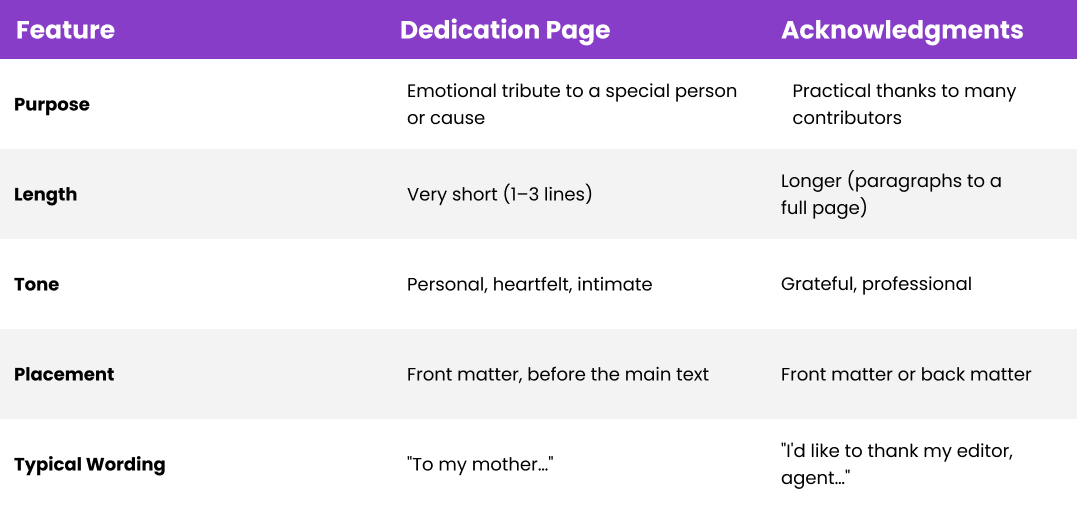
Think of it this way: the dedication is “this book is for you.” The acknowledgements are “here’s everyone who actually made it happen.”
Where Does the Dedication Page Go in a Book?
The dedication page sits in the front matter, the pages that come before your story or main content actually starts.
The standard order of front matter is generally:
- Half title page
- Title page
- Copyright page
- Dedication page
- Epigraph (optional quote)
- Table of contents
- Foreword / Preface / Introduction
By convention, the dedication goes on a right-hand (recto) page, with the back of that page left blank. It comes after the copyright page and before the table of contents, giving it its own page rather than sharing space with anything else.
For eBooks, the same order applies, the dedication just becomes its own screen or short section rather than a physical page.
Why the Dedication Page Matters
You might wonder whether such a small page is worth fussing over. It is, and here’s why.
It creates an emotional first impression. The dedication is one of the first things a curious reader sees, and a warm, clever, or moving line sets a tone and builds goodwill before the story even starts.
It honors the people behind the author. Writing a book is rarely a solo effort, and the dedication is a chance to publicly recognize someone whose support made the work possible.
It adds a personal touch. Readers like feeling a connection to the author, and a genuine dedication reminds them that a real person wrote the words they’re about to read.
It becomes a keepsake. For the person named, seeing their name in print is unforgettable, many dedicated treasure that page for life.
How to Write a Dedication Page in a Book (Step-by-Step)
Ready to write yours? Here are some steps to help you craft a dedication that feels authentic and polished.
Step 1: Decide Who (or What) to Dedicate the Book To
Start by thinking about who deserves this honor. Common choices include:
- A spouse, partner, parent, child, or close friend
- A mentor, teacher, or someone who inspired the book
- A person who has passed away (an “in memory of” dedication)
- A group, community, or cause connected to the book’s theme
- Your readers themselves
Choose someone with a genuine connection to you or the work, sincerity always beats flattery.
Step 2: Choose the Right Tone
Match the tone of your dedication to the spirit of your book and your relationship with the dedicatee. A children’s book might call for something playful, a memoir something tender, a thriller something understated. Your options run from heartfelt to humorous, inspirational, formal, or poetic.
Step 3: Keep It Short and Focused
Belongs in your acknowledgments instead.
The best dedications stay concise, aim for a single sentence or a short phrase. If you find yourself writing a full paragraph of thanks, that content probably belongs in your acknowledgments instead.
Step 4: Start With a Classic Opening (Optional)
Traditional dedications often open with a simple lead-in:
- “To…”
- “For…”
- “In memory of…”
- “Dedicated to…”
These openings are timeless and instantly signal that this is a dedication, that said, feel free to break convention if a more creative approach suits your voice.
Step 5: Add a Personal Touch (If You Wish)
You can leave it clean and simple, or add a brief phrase that reveals why this person matters:
“To my mother, who taught me that every story is worth telling.”
That short clause turns a name into a heartfelt tribute.
Step 6: Refine, Read Aloud, and Finalize
Read your dedication out loud. Does it sound sincere? Is every word necessary? Trim anything that feels excessive, double-check the spelling of names, and make sure it says exactly what you want, once it’s printed, it’s permanent.
Types of Book Dedications
Dedications come in a few different flavors. Here are the most popular styles, so you can find one that fits your book.
- The Heartfelt Dedication
The most common type, a sincere tribute to someone loved and appreciated.
For Sarah, my anchor in every storm. - The Memorial Dedication
Honors someone who has passed away, keeping their memory alive in print.
In loving memory of my grandfather, whose stories started it all. - The Humorous Dedication
Uses wit and playfulness, great for lighthearted books or authors with a comedic voice.
To my dog, the only one who read every draft without complaining. - The Inspirational Dedication
Speaks to readers or a broader group, often motivational in tone.
For everyone who was ever told they couldn’t. This one’s for you. - The Formal Dedication
Elegant and understated, common in academic or literary works.
Dedicated to my colleagues at the Institute, with deepest respect. - The Group Dedication
Recognizes a community, family, or cause rather than one individual.
To the teachers who never gave up on a struggling kid.
Book Dedication Examples for Inspiration
Sometimes seeing real-style examples is the fastest way to spark your own idea. Here’s a range across tones and situations.
Short and simple: For Mom and Dad.
Romantic: To James, every word is because of you.
For children: For my little dreamers, Lily and Noah. Always chase the stars.
Motivational: To anyone holding this book and wondering if they’re good enough, you are.
Witty: To coffee, without which none of this would exist.
In memory: In memory of Aunt Rose, who believed in this book before I did.
Reader-focused: For every reader who chose to spend their time here. Thank you.
Faith or gratitude: To God, and to the people who felt like His answer to my prayers.
Adapt any of these to fit your own voice, relationships, and story.
How to Format a Dedication Page
Great content deserves clean formatting. Here’s how to make your dedication page look professional.
Center the text. Dedications are traditionally centered both horizontally and vertically (or placed in the upper third of the page), giving the words some breathing room and visual balance.
Keep it uncluttered. The dedication should be the only text on the page, skip page numbers, headers, or decorations that compete with the message.
Use a subtle style choice. Many authors set the dedication in italics or a slightly different font to set it apart from the main body text. Keep it tasteful and consistent with your book’s design.
Match your book’s overall design. The font, spacing, and tone should feel cohesive with the rest of your front matter.
Leave the back blank. In print books, the reverse side of the dedication page is traditionally left empty so the dedication stands alone.
Don’t include a heading. You generally don’t need to write the word “Dedication” at the top, the short, centered text speaks for itself.
Common Dedication Page Mistakes to Avoid
Even a one-line page can go wrong. Here are the frequent errors to steer clear of.
Making it too long. A dedication that reads like a full acknowledgments section loses its impact. Keep it tight.
Naming too many people. When you dedicate a book “to everyone,” it stops feeling special. Save the spotlight for a select few.
Turning it into an acknowledgments list. Save your thanks to your editor, agent, beta readers, and publisher for the acknowledgments section.
Being vague to the point of confusion. Inside jokes are lovely, but an overly cryptic dedication can leave readers puzzled. A little clarity helps.
Misspelling names. This is the cardinal sin of dedication. Double-check every name and detail, a printed error can’t be undone.
Forcing sentimentality. Readers can sense insincerity. If a heartfelt tone doesn’t come naturally to you, a simple, honest line beats an exaggerated one.
Pro Tips for Writing a Memorable Dedication
Want your dedication to truly shine? Keep these tips in mind.
- Write from the heart, then trim. Draft freely, then cut it down to the most essential, powerful words.
- Read it as the dedicatee would. Imagine the person named opening the book and seeing it for the first time, does it land the way you intend?
- Let it reflect your book’s spirit. A dedication that echoes your book’s theme or tone feels intentional and cohesive.
- Consider surprise. If you’re dedicating the book to someone in your life, keeping it a secret until publication can make for an unforgettable moment.
- When in doubt, keep it simple. “For [name]” is timeless, elegant, and never wrong.
Do You Legally Need a Dedication Page?
No, a dedication page is entirely optional. There’s no legal, publishing, or industry requirement to include one, and plenty of successful books skip it altogether.
Include a dedication only if it feels meaningful to you. If there’s no particular person or cause you feel moved to honor, it’s fine to leave it out. A forced or empty dedication adds nothing, while a heartfelt one can add a great deal. The choice is yours.
Frequently Asked Questions
1- How long should a book dedication be?
Very short, usually one sentence or a brief phrase. If it stretches beyond two or three lines, consider moving the extra content to your acknowledgments section.
2- Can I dedicate a book to more than one person?
Yes, but keep the list small. Dedicating a book to one or two people (or a small group) preserves the sense of significance, naming too many people dilutes the effect.
3- Where exactly does the dedication page go?
In the front matter, after the copyright page and before the table of contents, traditionally on a right-hand page of its own.
4- Do I need to write the word “Dedication” at the top?
No, the centered text speaks for itself, and most books omit a heading. Adding one is optional but generally unnecessary.
5- Can dedication be funny?
Absolutely, humorous dedications work well for lighthearted books or authors with a playful voice. Just make sure the tone matches your book.
6- Is the dedication the same as the acknowledgements?
No, the dedication is a short, emotional tribute to a selected person or cause, while the acknowledgments section is a longer, practical thank-you to everyone who helped create the book.
7- Can I dedicate a book to a pet, a place, or an idea?
Yes, dedications can honor anyone or anything meaningful to you: a pet, a hometown, a cause, a value, even your readers. There are no rules about who or what qualifies.
8- Should the dedication be in italics?
It’s a common stylistic choice, but not required. Italics can help set the dedication apart from the main text, though a clean, centered standard font works just as well.
Final Thoughts
Now that you know how to write a dedication page, you have everything you need to craft a small page with a big impact. Keep it short, keep it sincere, choose the right tone, format it cleanly, and above all, make sure it reflects genuine feeling.
Your dedication doesn’t need to be poetic or elaborate. Whether it’s a single loving line to a parent, a witty nod to your morning coffee, or a heartfelt message to your readers, the best dedication is the one that’s true to you.
Take your time, choose your words with care, and give that special person, or cause, the tribute they deserve. When your book finally reaches readers’ hands, that quiet little page will be one of the most meaningful in the entire book.


