

What Is a Book Subtitle?
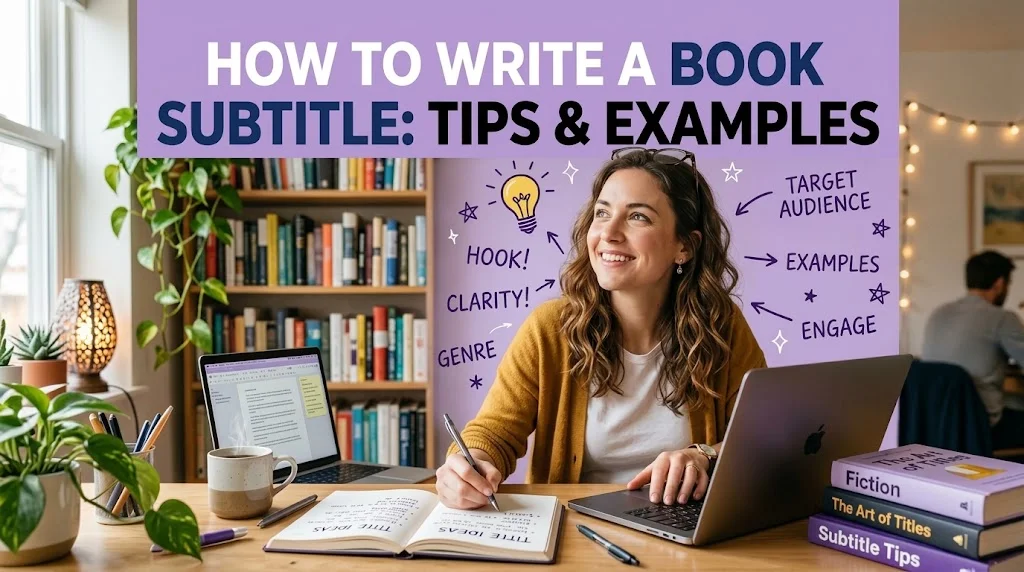
A book subtitle is the short line of text under or beside the main title that spells out exactly what a book delivers, its topic, its promise, or who it’s written for. If the title is the handshake, the subtitle is the sentence that follows it: concrete, specific, and built to remove guesswork for a browsing reader.
You’ll find the subtitle in three places: on the cover beneath the main title, on the title page, and in the book’s retail metadata on Amazon, Google Books, and library systems, which is exactly why a well-written subtitle can drive discoverability as much as it drives a sale on sight. For authors, coaches, and entrepreneurs publishing nonfiction, business, or self-help titles, the subtitle frequently carries more of the “why should I buy this” weight than the title itself. We’ve covered the subtitle’s basic mechanics on their own in What Is the Subtitle of a Book? This guide focuses on exactly how to write one that works.
Why Your Book Subtitle Matters
If you’re an author, coach, or entrepreneur putting a book into the world as a credibility asset, not just a creative one, your subtitle is doing measurable, trackable work in four places:
-
-
- Discoverability. Amazon, Google Books, and IngramSpark all index subtitle text as searchable metadata. The right keywords in your subtitle, used naturally rather than crammed in, can move your book into searches your title alone would never reach.
- Instant credibility. A business or self-help subtitle that names a specific framework, outcome, or audience signals expertise before a reader opens the book, which matters enormously if the book exists to book speaking gigs, consulting calls, or coaching clients.
- Conversion on your sales page. Your subtitle usually runs as the first line under your book’s headline on your website, your Amazon listing, and your email signature. A vague subtitle wastes that space; a specific one converts browsers into buyers.
- Category differentiation. In crowded nonfiction categories, two books with near-identical titles can look interchangeable until the subtitle clarifies which one actually solves the reader’s problem.
-
At eBook Writing, we’ve watched a rewritten subtitle single-handedly lift a stalled launch, usually because the original one described the book the author wished they’d written, not the one a reader actually needed to find. If your book exists to open doors, speaking stages, podcast bookings, inbound leads, it’s worth treating the subtitle with the same care as the title itself. Our business book ghostwriting services build exactly this kind of positioning work into the first workshop for founders, consultants, and coaches.
Book Title vs. Subtitle: What’s the Difference?
A title and a subtitle split one job between them. The title creates identity, it’s what goes on the spine, what someone says out loud when recommending your book. The subtitle creates clarity, it tells a reader, and a search engine, exactly what’s inside
| Feature | Title | Subtitle |
|---|---|---|
| Job | Identity, memorability | Clarity, specificity |
| Typical length | 1–5 words | 6–15 words |
| Tone | Can be abstract or poetic | Must be concrete |
| Indexed for search | Sometimes | Almost always |
| Needed in fiction | Always | Rarely |
| Needed in nonfiction | Always | Almost always |
How to Write a Book Subtitle: Step-by-Step Framework
Here’s exactly how to write a book subtitle that earns its place on the cover, in seven steps.
- Name your core promise first. Before you write a single word of the subtitle, answer one question in plain language: what does a reader actually walk away with after finishing this book? That answer is your raw material.
- Identify your exact reader. “Entrepreneurs” is too broad. “First-time SaaS founders raising a seed round” is a subtitle waiting to happen. The more specific your audience, the more your subtitle writes itself.
- Research how readers actually search. Check Amazon’s autocomplete, the “customers also bought” shelf on comp titles, and Google’s “People also ask” results for your topic. Borrow the exact phrases readers use, not the phrases you’d use in a pitch meeting.
- Draft 10 to 15 versions before you choose one. The best subtitle is rarely the first one you write. Draft in volume, then cut.
- Pick a structure and commit to it. Choose from the proven formulas below rather than inventing a new sentence shape from scratch.
- Cut it to 6–15 words. Longer subtitles get truncated in search results and crowd the cover design. If it doesn’t survive being read aloud in one breath, it’s too long.
- Read the title and subtitle together, out loud. If they sound like two unrelated phrases bolted together, or if the subtitle just restates the title, go back to step 1.
A subtitle this deliberate is hard to get right alone on a first pass, which is why most authors run it past a second pair of eyes, ours included, through a free 15-minute manuscript review , before it goes anywhere near the cover.
Proven Book Subtitle Formulas & Templates
You don’t need to invent a new sentence shape. Most working subtitles fit one of these five patterns, fill in your own brackets:
- The Outcome Formula: “[Title]: How to [Achieve Specific Result] Without [Common Obstacle]”
- The Framework Formula: “[Title]: The [Number]-Step System for [Outcome]”
- The Audience Formula: “[Title]: A Guide for [Specific Reader] Who Want[s] [Outcome]”
- The Descriptive Formula: “[Title]: A [Adjective] History/Guide/Look at [Topic]”
- The Narrative Formula: “[Title]: A Memoir of [Theme, Time Period, or Turning Point]”
Coaches and consultants writing an authority book tend to get the most mileage from the Outcome or Framework formula, since both put the book’s actual payoff in the first few words, exactly where a browsing reader’s eye lands first.
Book Subtitle Examples for Authors, Coaches & Entrepreneurs
Seeing the formulas in action makes them easier to copy. Here’s how they play out across the categories authors, coaches, and entrepreneurs write in most often:
| Genre | Title | Subtitle | Style |
|---|---|---|---|
| Business / Entrepreneurship | The Lean Pitch | How Bootstrapped Founders Raise Capital Without a Deck | Clear and benefit-driven |
| Coaching / Self-Help | Unstuck | A 6-Week Framework for Career Changers Starting Over at 40 | Specific and action-oriented |
| Memoir | Borrowed Time | A Memoir of Rebuilding After Bankruptcy | Personal and descriptive |
| Nonfiction / Reference | The Quiet Ledger | A Field Guide to Reading a Balance Sheet Like a Founder | Practical and descriptive |
Notice that none of these restate the title, each one adds information the title deliberately left out. That’s the test worth applying to your own draft before you move on.
Common Book Subtitle Mistakes to Avoid
- Being vague. A subtitle that could apply to five other books in your category isn’t doing its job.
- Keyword-stuffing. Cramming in every term you want to rank for reads like a list, not a promise, and often hurts conversion more than it helps discoverability.
- Going too long. Amazon, Google, and most cover designs truncate anything past roughly 15 words.
- Restating the title. If your subtitle just rephrases the title, cut it, it’s adding length, not information.
- Ignoring genre expectations. A punchy, benefit-driven subtitle looks out of place on a literary novel; a vague, poetic one undersells a practical how-to guide.
- Skipping a second opinion. Authors are too close to their own book to spot a flat subtitle. A professional editing pass usually catches this before it ships.
Book Subtitle Checklist
Run your draft against this list before it goes anywhere near your cover designer:
- It adds information the title doesn’t already give
- It names the audience, the outcome, or both
- It’s between 6 and 15 words
- It survives being read aloud in one breath
- It includes at least one phrase readers actually search for
- It matches the tone of your title and your genre
- It’s been read by someone other than you
Once it passes, it’s ready to hand to your cover design team, subtitle length and word-breaks directly affect how a cover’s typography gets set, so it’s worth locking the wording before layout begins.
FAQs About Writing a Book Subtitle
How long should a book subtitle be?
Most working subtitles run 6 to 15 words. Shorter risks sounding incomplete; longer gets truncated in search results and on retailer listings, and crowds the cover design.
Does every book need a subtitle?
No. Subtitles are close to standard in nonfiction, where readers want to know the exact payoff before buying. Fiction mostly skips them, except in memoir, historical fiction, and series entries that need to signal where a book fits.
What’s the difference between a subtitle and a tagline?
A subtitle is descriptive and part of the book’s actual name, it appears on the cover, the title page, and in retailer metadata. A tagline is a separate, punchier marketing line used mostly in ads and on landing pages.
Can a subtitle improve my book’s ranking on Amazon?
Yes. Amazon indexes subtitle text as searchable metadata, so a subtitle built around the terms your readers actually search for can meaningfully improve how easily your book gets found.
Should I write my subtitle before or after my title?
Usually after. Lock the title’s identity first, then write the subtitle to fill in whatever the title deliberately leaves out. Writing them in the opposite order tends to produce a subtitle that just repeats the title.
Can I change my Subtitle after my book is published?
On most self-publishing platforms, yes, subtitles are typically far easier to update post-launch than titles, which makes them a useful lever if a book underperforms in search.
Get Expert Help Writing Your Book Subtitle
A strong subtitle is a small amount of text carrying a genuinely large job, it’s often the difference between a reader scrolling past your book and a reader clicking to learn more. If you’d rather not run the formulas yourself, this is one of the things eBook Writing does as a matter of course for every manuscript we touch, from business books built to book speaking stages to memoirs built to find the right reader.
Start with a free 15-minute manuscript review and we’ll tell you whether your title-and-subtitle pair is pulling its weight. If you’re earlier in the process, our business and self-help book ghostwriting services fold subtitle and positioning work into the very first workshop, and our non-fiction ghostwriting services do the same for research-led and how-to titles. Once the wording is locked, our book cover design team sets it in the type that actually sells on a shelf.
Request a quote , no obligation, fixed-price proposal within 48 hours.