


We’ve all been there. You sit down, open a blank document, and… nothing. The cursor blinks at you, mocking your lack of inspiration. Minutes turn into hours, and suddenly, checking your email for the fourteenth time feels like a productive use of time.
Writer’s block isn’t a lack of talent; it’s a temporary traffic jam in your brain. In fact, neuroscientists note that when you experience writing anxiety, stress triggers the limbic system (the brain’s emotional survival center), shifting control away from the cerebral cortex, the area responsible for creative and complex language processing. Essentially, your brain treats a blank page like a physical threat, forcing you into “creative freeze” mode. 1
The good news? You don’t have to wait for a magical burst of inspiration to clear the roads. Here are 7 simple, scientifically proven techniques to smash through writer’s block and get your words flowing again.
1. Try “Freewriting” (The No-Judgment Zone)
Often, writer’s block is actually your internal editor screaming too loudly. You try to write the perfect first sentence, get intimidated, and freeze.
Psychologist Joy Paul Guilford’s pioneering research on creativity notes that writing requires two entirely different cognitive processes: divergent thinking (generating raw ideas) and convergent thinking (evaluating and editing them). Writer’s block happens when you try to do both at the same time. 2
To bypass this, try freewriting:
- Set a timer for 5 to 10 minutes.
- Start typing and do not stop for any reason.
- Do not fix typos, do not backspace, and do not look back.
By separating the “generation” phase from the “editing” phase, you lower the cognitive load on your brain, letting the raw material slip past your internal critic.
2. Change Your Environment
If you’ve been staring at the same four walls for hours, your brain goes into a cognitive rut. Environmental psychology shows that a simple change of scenery triggers a release of dopamine, the neurotransmitter responsible for motivation and novelty-seeking, which can stimulate new creative breakthroughs. 3
- Move to a coffee shop for ambient noise (studies show moderate ambient noise actually enhances abstract creativity). 4
- Take your laptop to a park to engage with natural environments, which lowers cortisol (stress) levels. 5
- Switch your digital environment: Change your document font to something casual like Comic Sans. Psychological tricks like this temporarily lower your brain’s performance expectations, reducing anxiety.
3. Write the Middle First
There is a strange rule in writing: You do not have to write a piece in the order it will be read. Introductions are notoriously difficult because you’re trying to set the stage for something that doesn’t exist yet.
According to Cognitive Load Theory, trying to figure out how to start a piece while simultaneously trying to figure out what you actually want to say creates mental gridlock. Skip the intro. If you know exactly what points you want to make in the body paragraphs, start there. Once the meat of the piece is written, the introduction usually writes itself. 6
4. Use the Pomodoro Technique
When a project feels massive, the sheer scale of it causes paralysis. The fix? Make the commitment laughably small. Using the Pomodoro Technique, you commit to writing for just 25 minutes, followed by a 5-minute break.
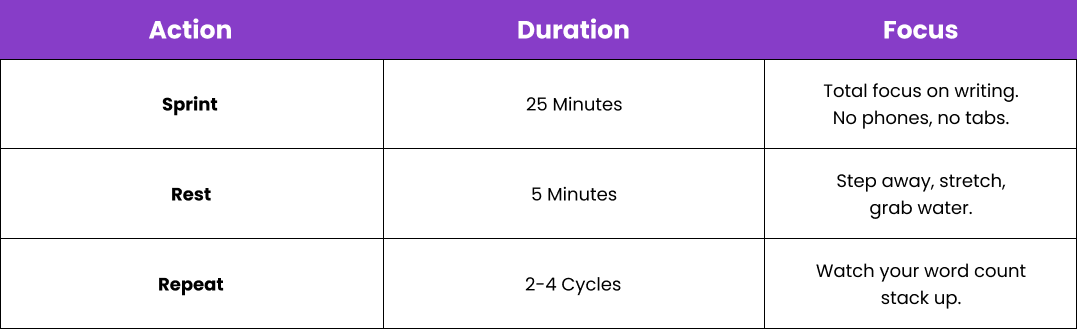
Psychologists specializing in procrastination note that human motivation is heavily tied to the “momentum effect.” Knowing you only have to endure 25 minutes lowers the psychological barrier to entry. Once you start, the brain’s desire to complete a started task kicks in, making it easier to keep going. 7
5. Talk It Out (Dictation)
Sometimes our fingers can’t keep up with our thoughts, or the act of typing feels too formal. When you’re stuck, try speaking instead.
Open a voice memo app on your phone or use a built-in dictation tool. Pace around your room and explain your idea out loud as if you were telling a friend about it. Because vocal communication utilizes slightly different cognitive tracks than formal handwriting or typing, dictation bypasses the hyper-critical filters that cause text-based block.
6. Lower the Stakes with a “Shitty First Draft”

The legendary author Anne Lamott famously coined the term “shitty first drafts.” Give yourself permission to write absolute garbage. Renowned writing psychologist Dr. Ronald Kellogg found that regular writing practice reduces the demands on working memory. By intentionally aiming for a low-quality first draft, you remove the fear of negative judgment. You are just dumping the clay on the wheel; you can sculpt it into art later. 8
7. Do Something Mindless (The Incubation Phase)
If you force a puzzle piece that doesn’t fit, you just bend the cardboard. The same goes for your brain. If you are completely stuck, step away and do a low-stakes, repetitive physical task like washing the dishes, taking a shower, or going for a walk.
This isn’t slacking off; it’s a verified psychological stage of creativity called incubation. A review published in Frontiers of Human Neuroscience confirmed that even when we consciously take a break from a project, our brain’s Default Mode Network (DMN) continues tinkering with the problem unconsciously. It’s why our best insights always seem to strike when we are in the shower or walking the dog. 9
Wrap-Up: Just Push the First Domino
Writer’s block thrives on stillness. The longer you sit there doing nothing, the heavier the block becomes.
The next time you find yourself stuck, don’t wait for inspiration to strike. Pick just one of the techniques above and commit to it for 10 minutes. Action precedes motivation, once you get that first domino to fall, your brain’s chemistry will do the rest.
Now, close this tab, open your draft, and go write a terrible first sentence!
References & Scientific Endnotes
- Arnsten, A. F. T. (2009). Stress signalling pathways that impair prefrontal cortex structure and function. Nature Reviews Neuroscience, 10(6), 410–422. (Discusses how stress triggers the limbic system and bypasses higher-order cortical processing).
- Guilford, J. P. (1950). Creativity. American Psychologist, 5(9), 444–454. (Classic study laying the foundation for separate creative tracks: divergent idea generation vs. convergent analytical editing).
- Berridge, K. C., & Robinson, T. E. (1998). What is the role of dopamine in reward: hedonic impact, reward learning, or incentive salience? Brain Research Reviews, 28(3), 309–369. (Details how structural novelty impacts dopamine pathways to drive motivation).
- Mehta, R., Zhu, R., & Cheema, A. (2012). Is noise always bad? Exploring the effects of ambient noise on creative cognition. Journal of Consumer Research, 39(4), 784–799. (Demonstrates that a moderate level of environmental ambient noise—70 dB, equivalent to a coffee shop—boosts abstract creativity).
- Ulrich, R. S., Simons, R. F., Losito, B. D., Fiorito, E., Miles, M. A., & Zelson, M. (1991). Stress recovery during exposure to natural and urban environments. Journal of Environmental Psychology, 11(3), 201–230. (Shows rapid physical and cognitive stress recovery via lower cortisol when interacting with natural environments).
- Sweller, J. (1988). Cognitive load during problem solving: Effects on learning. Cognitive Science, 12(2), 257–285. (Explains how simultaneous complex structural tasks overload the limited capacity of working memory).
- Steel, P. (2007). The nature of procrastination: A meta-analytic and theoretical review of quintessential self-regulatory failure. Psychological Bulletin, 133(1), 65–94. (Highlights the psychological power of breaking tasks into microscopic steps to generate behavioral momentum).
- Kellogg, R. T. (1996). A model of working memory in writing. In C. M. Levy & S. Ransdell (Eds.), The Science of Writing (pp. 57–72). Lawrence Erlbaum Associates. (Proves that suppressing evaluative constraints maximizes output by freeing up central executive working memory resource pools).
- Sio, U. N., & Ormerod, T. C. (2009). Does incubation enhance problem solving? A meta-analytic review. Psychological Bulletin, 135(1), 94–120. (Validates that diverting conscious focus to a low-demand physical task activates the default mode network to achieve sub-conscious creative breakthrough).